Advancing Fashion Visual Merchandising Pedagogy With an Omni-Channel Retailing Framework
An experiential instructional model for advancing visual merchandising pedagogy in fashion higher education
Presented by:
Yuhui (Jessie) Liu, University of the Incarnate Word
Hear it from the author:
Transcript:
Hello, my name is Yuhui Liu, and I usually go by Jessie.
This presentation is about how we can advance visual merchandising education through an omni-channel experiential learning framework.
Now fashion consumers engage with brands across both physical stores and digital platforms. However, traditional merchandising education still focuses mainly on in-store experiences, so there’s a gap between academic training and industry needs.
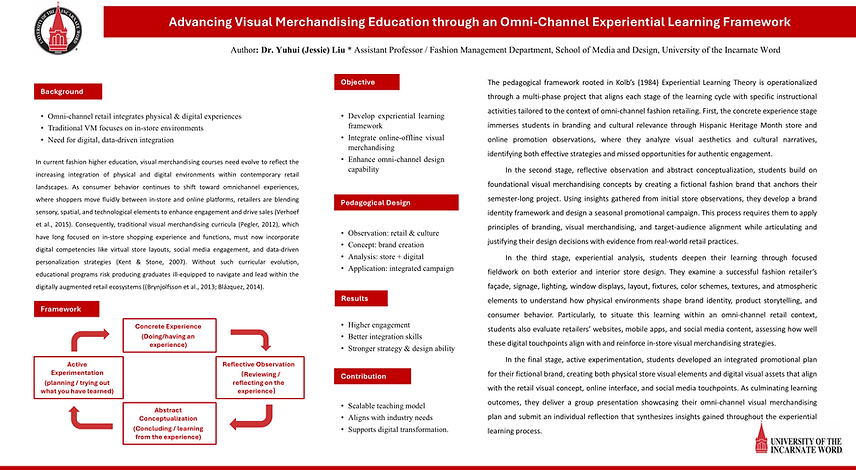
This study applies Experiential Learning Theory to design a project-based course model, structured around four stages: observation, conceptual development, experiential analysis, and active experimentation.
Students begin by analyzing a real retail promotion case and then apply these insights to develop their own projects.
Welcome to see my poster. Thank you!
Key Words:
Fashion Merchandising, Retail, Experiential Learning
Abstract:
This study presents an experiential instructional model for advancing visual merchandising pedagogy within an omni-channel context in fashion higher education. Grounded in Kolb’s (1984) Experiential Learning Theory, the multi-stage project integrates store observations, brand development, real-case analysis, and cross-platform media design to reflect the convergence of physical and digital retail environments. Students create a fictional brand and develop a cohesive promotional strategy across in-store and online touchpoints. Assessment of learning outcomes indicates strengthened technical skills, strategic thinking, and engagement. This scalable approach offers a relevant framework for preparing students to navigate today’s digitally integrated and culturally diverse retail landscape.
Outcomes:
1. Describe how omni-channel strategies can be integrated through an experiential learning framework to enhance student engagement and industry readiness in visual merchandising courses.
2. Analyze the four stages of Kolb’s Experiential Learning Theory as they apply to physical store analysis, digital touchpoint evaluation, and omni-channel promotional design activities.
3. Create an actionable plan for applying experiential learning to strengthen digital integration in visual merchandising curricula in response to current industry talent requirements.
References:
Verhoef, P. C., Kannan, P. K., & Inman, J. J. (2015). From multi-channel retailing to omni-channel retailing: introduction to the special issue on multi-channel retailing. Journal of retailing, 91(2), 174-181.
Kolb, D. A. (1984). Experiential learning: Experience as the source of learning and development. Englewood Cliffs, NJ: Prentice-Hall.
Beard, C., & Wilson, J. P. (2013). Experiential learning: A handbook for education, training and coaching (3rd ed.). Kogan Page.