How AI Policy Shapes Perceived Fairness, Belonging, and Academic Engagement
Explores how inconsistent AI policies in first-year courses affect students’ fairness perceptions, belonging, and engagement, offering strategies for equitable guidelines that support confidence and retention.
Presented by:
Maedeh Gholamzadehmi, University of Oklahoma
Jorge Restrepo Garcia, University of Oklahoma
Adrienne R. Carter-Sowell, University of Oklahoma
Hear it from the author:
Transcript:
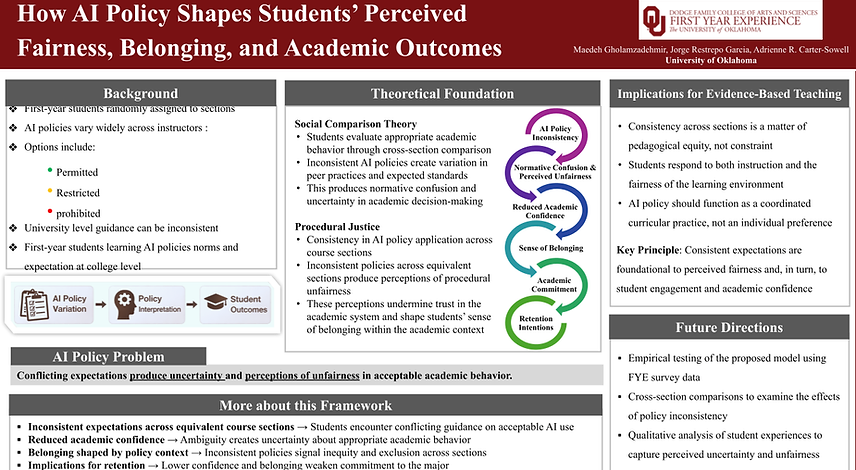
This poster looks at how variation in AI policy across course sections shapes students’ perceptions of fairness, belonging, and academic outcomes.
In many first-year courses, students are randomly assigned to sections, but AI policies can differ quite a bit across instructors—some allow it, some restrict it, and some prohibit it entirely. As a result, students are navigating different expectations for what counts as acceptable academic behavior.
We draw on social comparison theory and procedural justice to suggest that students don’t experience these policies in isolation—they compare them across sections. When those expectations feel inconsistent, it can lead to confusion and perceptions of unfairness.
In our model, that interpretation process is key. Perceived inconsistency leads to normative confusion and reduced academic confidence, which then affects students’ sense of belonging, their commitment, and ultimately their retention intentions.
The main takeaway here is that consistency across sections is not just about coordination—it’s about equity. Students respond not only to instruction, but to how fair and coherent the learning environment feels.
Going forward, we’re testing this model using survey and qualitative data from first-year experience courses to better understand how policy design can support student success.
Key Words:
AI Policy, Belonging, Retention
Abstract:
AI is rapidly being integrated into higher education, yet students in First-Year Experience programs face inconsistent guidance about how it should be used. Because students are randomly placed in different course sections, they face conflicting expectations: some instructors encourage AI tools, while others prohibit them. This inconsistency creates confusion and anxiety, leaving students uncertain about acceptable academic behavior. Grounded in social comparison theory and organizational justice, we examine how different AI policies affect students’ belonging, academic confidence, and commitment to their major. We expect that policy inconsistency correlates with lowest confidence and belonging through perceptions of unfairness, ultimately affecting retention.
Outcomes:
1. How inconsistent faculty AI policies influence first-year students’ perceptions of fairness, belonging, and academic confidence within the FYE context.
2. The relationship between policy inconsistency and key student outcomes—such as engagement, major commitment, and retention—through the lens of social comparison theory and organizational justice.
3. Strategies and recommendations for creating coherent, equitable AI policy structures that promote student confidence, belonging, and responsible use of AI tools in higher education.
References:
Gopalan, M., & Brady, S. T. (2020). College students’ sense of belonging: A national perspective. Educational Researcher, 49(2), 134–137.
Luo, Jiahui (Jess). (2024). A critical review of GenAI policies in higher education assessment: A call to reconsider the “originality” of students’ work. Assessment & Evaluation in Higher Education, 49(5), 651–664.
Marín, V. I., Bond, M., & Gouverneur, F. (2019). Systematic review of research on artificial intelligence applications in higher education. International Journal of Educational Technology in Higher Education, 16(1), 39.