Keeping Students Cognitively Active: Evidence-Based Strategies for Math-Heavy Engineering Courses
Explore evidence-based techniques that increased student engagement and performance in math-heavy engineering courses through active participation, reduced distractions, and strategic course design.
Presented by:
Stanley Baek, United States Air Force Academy
Hear it from the author:
Transcript:
Key Words:
Student Engagement, STEM Education, Instructional Design
Abstract:
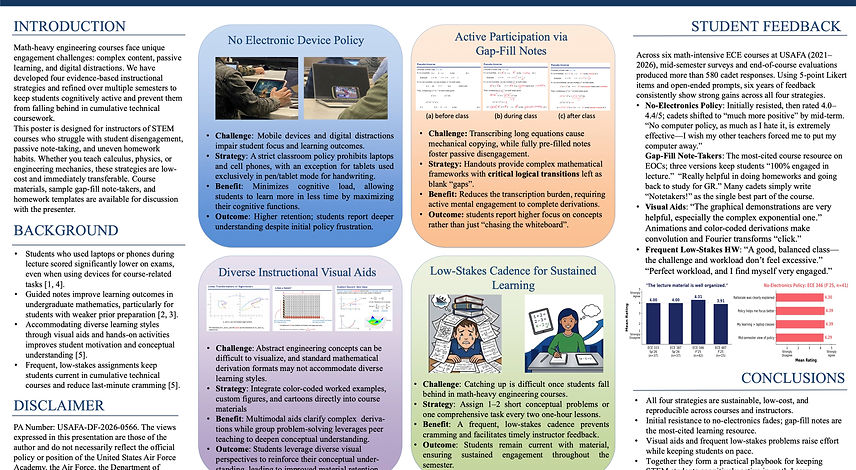
Math-heavy engineering courses face unique engagement challenges: complex content, passive learning, and digital distractions. This poster shares four evidence-based strategies that transformed student engagement: (1) eliminating electronic devices to reduce cognitive load, (2) implementing gap-fill note-takers that balance active participation with efficiency, (3) accommodating diverse learning styles through visual aids and hands-on activities, and (4) designing balanced workloads with frequent feedback. Student surveys demonstrate high satisfaction with these approaches. Participants will examine course materials, discuss implementation challenges, and leave with actionable techniques and templates ready for immediate classroom application.
Outcomes:
1. Understand how to implement gap-fill note-takers that promote active engagement while reducing the note-taking burden in technical courses.
2. Identify strategies to accommodate diverse learning styles through visual aids, hands-on activities, and varied instructional approaches in math-heavy courses.
3. Design balanced homework structures with frequent, manageable assignments that provide timely feedback and maintain student engagement throughout the semester.
References:
Krapf, R., Pfefferkorn, L. (2022) How Does the Provision of Guided Notes Affect Student Learning in Undergraduate Mathematics?. Int. J. Res. Undergrad. Math. Ed. 8, 642–670.
https://link.springer.com/article/10.1007/s40753-021-00160-x
Chen, Q., Yan, Z., Moeyart, M., & Bangert-Drowns, R. (2024). Mobile multitasking in learning: A meta-analysis of effects of mobile phone distraction on young adults' immediate recall. Computers in Human Behavior, 160, 108432.
Feudel, F., & Panse, A. (2022). How does the provision of guided notes affect student learning in undergraduate mathematics? International Journal of Research in Undergraduate Mathematics Education, 8(1), 126-150.
Felder, R. M., & Brent, R. (2015). Handouts with gaps. Chemical Engineering Education, 49(4), 239-240.
Ravizza, S. M., Uitvlugt, M. G., & Fenn, K. M. (2017). Logged in and zoned out: How laptop internet use relates to classroom learning. Psychological Science, 28(2), 171-180.
Cho, H. J., Zhao, K., Lee, C. R., et al. (2021). Active learning through flipped classroom in mechanical engineering: Improving students' perception of learning and performance. International Journal of STEM Education, 8, 1-13.